- Death of Fujisawa Shuko
- Ch'oe wins Ing Cup
- Gu wins BC Card Cup, first to achieve quintuple crown
- Korea does well in 22nd Fujitsu Cup
- 14th LG Cup qualifying tournament
- Cho U takes Judan title, is first to achieve quintuple crown
- Xie wins 21st Women's Meijin title
- Yuki wins NHK Cup
- Takao challenging for Honinbo title, Hane makes good start
- Iyama wins Daiwa Net Grand Champion tournament
- 34th Meijin League
- Michael Redmond reaches 500-win landmark
- Gosei challenger: Yuki or Iyama
- Promotions
- Kubomatsu Katsukiyo promoted to 9-dan
- A marriage
- Retirement
20 May
Obituary
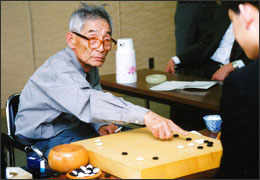
Death of Fujisawa Shuko
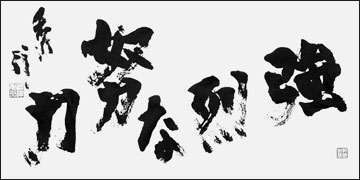
One of the greats has passed from the go scene. At 7:16 a.m. on 8 May, Fujisawa Hideyuki (Shuko), Honorary Kisei, died of pneumonia at St. Luke's International Hospital in Tokyo. He was 83. His health took a turn for the worse when he twice broke a leg towards the end of last year. His final appearance in public was at an exhibition of his calligraphy late in the year that he attended in a wheelchair. He returned home once, but contracted pneumonia and had to be hospitalized again in March this year. However, he forbade any artificial life-extension procedures (one of the banes of terminal medical care in Japan, where hospices are rare, and patients may be kept breathing by machines after brain death). He commented: `I've played enough go. I beat cancer three times. I've lived the way I wanted to live. I'll live until I die. I don't want to live like someone dead.' Shuko had indicated in interviews in recent years that he was ready for death, which is a consolat on for his fans. He sometimes commented on his surprise that the `call' from the grim reaper was so slow in coming; considering his medical history, he certainly hadn't expected to live into his 80s.
Although the `correct' reading of his given name is Hideyuki, Fujisawa was universally known as Shuko (the Sino-Japanese reading of the characters used to write his name; actually, he was named Tamotsu at birth, but later changed that to Hideyuki). He was one of the top half dozen players of the second half of the 20th century in Japan, though his turbulent lifestyle prevented him from amassing as many titles as some other players. Among his contemporaries, he ranks with Go Seigen and Sakata Eio for his creativity and the depth of his understanding of the essential nature of go. His two greatest achievements were becoming the first tournament Meijin in 1962 and winning the first six terms of the Kisei title from 1977 to 1982, but there was also a nice climax to his career when he set a record for the oldest holder of a top-seven title by winning the Oza title at the age of 66 (he extended that record when he defended it the following year). In all, he won 23 titles.
Shuko was perhaps most famous (notorious) for the flamboyance of his lifestyle, being addicted to drinking and gambling and running up enormous debts, although he sometimes claimed that he was thinking of go all his waking moments. He was a legendary drinker, but he summoned up extraordinary willpower to go on the wagon a month before his Kisei title defences. During the latter part of his life, he also fought three successful bouts with cancer.
In one way, Shuko's legacy outshines his contemporaries and rivals that of Kitani Minoru. Although he had a relatively small number of actual disciples, Shuko was a great teacher and all his life he gave generously of his time to train younger players, including players from Korea and, especially, China, where he was a widely respected and much-loved figure. In fact, probably no other player has been so widely respected and loved by other go professionals. Starting with the late Kato Masao and Cho Hun-hyeon of Korea, who played hundreds of teaching games with him early in their careers (Kato would visit him at his office in Yoyogi where Shuko was ostensibly running a real-estate business at one stage in his career), many of his juniors benefited from his instruction, especially in the regular training camps he held every summer and winter in recent decades. His most prominent disciple at present is Takao Shinji, who would constantly send games to Shuko for review. Takao is not a gambler, but he would go out to the professional cycling track (Shuko's favourite form of gambling), where Shuko would look at his game records in-between races and give his criticisms (Takao says he was almost never praised).
Shuko's career has been amply documented in English, especially in the magazine Go World. Our favourite match from his career has always been the Kisei title match with Kato Masao in 1978, in which he showed great creativity and extraordinary powers of concentration.
In accordance with his wishes, attendance at Shuko's funeral was restricted to immediate family and very close friends. He requested that his ashes be scattered in the sea off the shrine of Itsukushima, near Hiroshima.
International news
Ch'oe wins Ing Cup
Ch'oe Ch'eol-han 9-dan of Korea has scored the biggest success of his career by defeating Yi Ch'ang-ho 9-dan, also of Korea, 3-1 in the final of the 6th Ing Cup. Ch'oe takes the first prize of $400,000. The final game was played in Taiwan.
Ch'oe was born in 1985. This is his second international title-he won the Taiwanese-sponsored Zhonghuan Cup in 2005.
Game 1 ( 3 March ). Yi (W) by 3 points.
Game 2 ( 5 March ). Ch'oe (W) by 6 points.
Game 3 ( 7 March ). Ch'oe (B) by resig.
Game 4 ( 23 April ). Ch'oe (W) by resig.
Gu wins BC Card Cup, first to achieve quintuple crown
In the final of the 1st BC Card Cup, Gu Li 9-dan of China beat Cho Han-seung 9-dan of Korea 3-1 to win the inaugural term of this tournament. Gu won a prize of 300 million won and became the first player to hold five international titles simultaneously. Despite his modest disclaimer when he won the fourth of these that he still considered Yi Se-tol of Korea his target, he is now indisputably the world's number one player.
Quarterfinals:
( 23 April ) Yi Se-tol 9-dan (Korea) (B) defeated Pak Yeong-hun 9-dan (Korea) by resig.
( 24 April ) Cho Hun-hyeon 9-dan (Korea) (W) d. Han Ung-kyu 1-dan (Korea) by half a point.
( 25 April ) Cho Han-seung 9-dan (Korea) (W) d. Huang Yizhong 7-dan (China) by 6.5 points.
( 26 April ) Gu Li 9-dan (China) (B) d. Piao Wenyao 5-dan (China) by resig. |
Semifinals:
( 29 April ) Cho Han-seung (B) d. Yi Se-tol by resig.
( 30 April ) Gu Li (W) d. Cho Hun-hyeon by half a point. |
Final:
Game 1 ( 1 May ). Gu (W) by resig.
Game 2 ( 2 May ). Cho (W) by resig.
Game 3 ( 3 May ). Gu (W) by resig.
Game 4 ( 4 May ). Gu (B) by resig. |
Korea does well in 22nd Fujitsu Cup
Korean players have shown their usual skill on the international scene, taking four of the quarterfinal places in the 22nd Fujitsu Cup, with two each going to China and Japan. Both Yis, Se-tol and Ch'ang-ho, who are multiple Fujitsu Cup winners, are among the four from Korea, so they should perhaps be considered the favourites, especially as the previous winner, Gu Li of China, was eliminated in the second round by Kono Rin of Japan. Actually, Japan had a marvellous start, with all six players winning their games in the first round, but they failed to match this effort in the second round.
Results to date:
Round 1 (11 April, Tokyo):
Kono Rin 9-dan (Japan) (W) d. Kong Jie 7-dan (China) by resig.
Hane Naoki 9-dan (Japan) (B) d. Li Jie, amateur 7-dan, (USA) by resig.
Qiu Jun 8-dan (China) (W) d. Lin Zhihan 8-dan (Taiwan) by resig.
Xie He 7-dan (China) (B) d. Ch'oe Ch'eol-han 9-dan (Korea) by resig.
Iyama Yuta 8-dan (Japan) (W) d. Weon Seong-chin 9-dan (Korea) by resig.
Cho U 9-dan (Japan) (B) d. Fernando Aguilar, amateur 7-dan, (Argentina) by resig.;
Moriyama Naoki 9-dan (Japan) (B) d. Franz-Josef Dickhut, amateur 6-dan, (Germany) by resig.
Takao Shinji 9-dan (Japan) (W) d. Zhou Ruiyang 5-dan (China) by resig. |
Round 2 (13 April, Tokyo):
Kono (W) d. Gu Li 9-dan (China) by resig.
Yamashita Keigo 9-dan (Japan (B) d. Qiu by resig.
Chang Hao 9-dan (China) (B) d. Hane by resig.
Piao Wenyao 5-dan (China) (B) d. Moriyama by 2.5 points.
Yi Ch'ang-ho 9-dan (Korea) (B) d. Takao by resig.
Yi Se-tol 9-dan (Korea) (B) d. Cho by resig.
Pak Yeong-hun 9-dan (Korea) (B) d. Xie by 1.5 points.
Kang Tong-yun 9-dan (Korea) (W) d. Iyama by resig. |
14th LG Cup qualifying tournament
The international qualifying tournament for the 14th LG Cup was held in Seoul from 15 to 20 April with over 300 professionals from China, Korea, Japan, and Taiwan, including a number of former world champions, competing for the 16 seats in the main tournament that were at stake. Nine of these went to Korean players and the other seven to Chinese. Of the 58 players from Japan, two, Oya Koichi 9-dan and Tsuruyama Atsushi 6-dan, reached the final round but were unsuccessful, the former losing to Hu Yaoyu 8-dan of China and the latter to Hong Min-p'yo 6-dan of Korea.
Cho U takes Judan title, is first to achieve quintuple crown
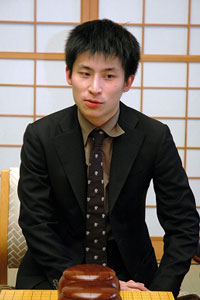
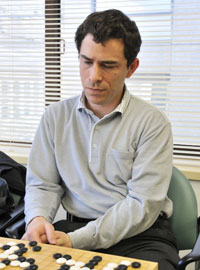
Cho U has become the first player to hold five top-seven titles simultaneously since the present top-seven system came into being in 1977. He accomplished this feat by beating Takao Shinji 3-1 in the 47th Judan title match. His other four titles are the Meijin, Tengen, Oza, and Gosei. He has won the Honinbo title in the past, so if he can win the Kisei title in the future he will become the second player, after Cho Chikun, to complete a `grand slam' of the seven titles. Already some go journalists are saying that if anyone is going to do it, it will be Cho who first achieves a real grand slam, that is, holding all top seven titles simultaneously. That's speculation; what is not speculation is the fact that Cho U has consolidated his position as the monarch of Japanese go.
Our previous report covered the first game. Game Two was played at the Takashimaya Hotel in Niigata City on 18 March. As with the first game, it was held in conjunction with the Women's Meijin title match, Game Two of which was played at the same venue on the previous day with the same staff (referee Kudo Norio 9-dan, commentator Akiyama Jiro 8-dan, and the same game recorders). The results were also similar, in that both games were won by the challengers. In the Judan game, Cho had black and he won a victory thanks to his superb positional judgement, specifically in the compensation he took in return for losing a ko.
In a departure from the pattern so far, the third game was not held in conjunction with the Woman's Meijin title match. It was played at the Kuroyon Royal Hotel in Omachi City, Nagano Prefecture on 9 April. After a series of fierce ko fights and resulting trades, Cho managed to kill a large group, forcing Takao to resignaiton.
The fourth game was played at the Shunkei Roman Ginpaso hotel at Nishiura Hot Spring, Gamagori City, Aichi Prefecture on 16 April. Takao outplayed Cho and seemed to be heading for a win when he suddenly started playing erratically. Inexplicably, he ignored a potent ko threat in a fight in which he was leading in ko threats anyway. That let Cho kill a group and so pull off a major upset. The game ended with Takao's resignation after 157 moves.
While Cho is riding high with five titles, Takao, who not so long ago took both the Honinbo and Meijin titles from him, finds himself an untitled 9-dan.
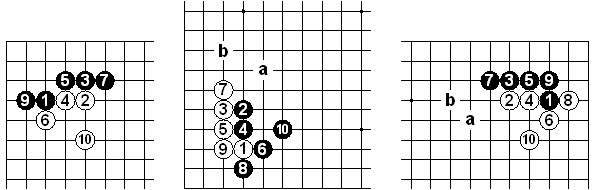
In passing, one of the features of this series was that a simple version of the large-avalanche joseki was played in all four games (shown in order in the diagrams below). Each time, Cho was the one playing on the outside, so he obviously believes that this variation is good for him or at least that it suits his style. On the other hand, Takao obviously had no dissatisfaction with taking the inside in each case. That makes it seem likely that the result is equal, but even so it is unusual for the same joseki to appear in every game of a series. It reminds one of the Kisei series between Fujisawa Shuko and Kato Masao, when the high version of the Chinese Opening was played in every game.
In the second diagram, White ignored Black `a', so Black later also played `b'. In the third diagram, the exchange of White `a' and Black `b' took place. In the fourth game, the same sequence as in the second diagram appeared.
| Full results: |
Game 1 ( 5 March ). Takao (B) by 2 1/2
Game 2 ( 18 Marc ). Cho (B) by resig.
Game 3 ( 9 April ). Cho (W) by resig.
Game 4 ( 16 April ). Cho (B) by resig. |
Quadruple crowns
Cho is the first player to hold five top-seven titles simultaneously, but three players have held four. They are:
| Kato Masao (twice) |
: |
November 1979 to April 1980 (Honinbo, Judan, Tengen, Oza)
August 1987 to April 1988 (Meijin, Judan, Oza, Gosei) |
| Cho Chikun |
: |
March 1983 to April 1983 (Kisei, Meijin, Honinbo, Judan) |
| Kobayashi Koichi |
: |
March 1986 to October 1986 (Kisei, Meijin, Judan, Tengen). |
Cho Chikun is the only player to have held the top four at the same time.
Xie wins 21st Women's Meijin title
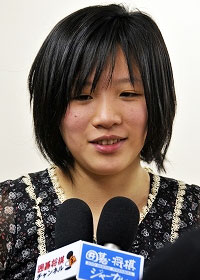
Xie Yimin completed her first successful defence of the Women's Meijin title when she defeated Chinen Kaori 4-dan 2-1 in the title match. The deciding game was played at the Nihon Ki-in. Xie made a bad start, but she bore up patiently under attack until she got a chance to make a counterattack. In the end, she staged an upset by living inside her opponent's main territory. The Taiwanese-born Xie, who is still only 19, has now held both the Women's Meijin and the Women's Honinbo titles for two years in a row, so she is at present the top woman player in Japan. Her goal now will be to win some games for Japan in international competition.
| Results: |
Game 1 ( 4 March ). Xie (W) by resignation.
Game 2 ( 19 March ). Chinen (W) by 3.5 points.
Game 3 ( 1 April ). Xie (B) by resignation. |
Yuki wins NHK Cup
Yuki Satoshi 9-dan of the Kansai Ki-in has achieved one of his most cherished ambitions by winning the 56th NHK Cup. In the final, telecast on 26 March, he defeated Takemiya Masaki 9-dan with black. Takemiya has been in great form this year-he attributes it to putting in three hours a day practising ballroom dancing, which he says has taken 20 years off his age-and even playing white he managed to set up a large moyo. However, one slack move allowed Yuki to rip it apart.
When his victory became certain, Yuki was visibly moved-his lips were quivering-which shows how much winning this title meant to him. Although he had previously won eight fast-go and minor titles, the 37-year-old Yuki has underperformed as the top player at the Kansai Ki-in. He has not won a top-seven title, though he has challenged for the Kisei once and the Gosei three times. The NHK Cup may not be a big title, but it has very wide exposure, so winning it gives your reputation a big boost. This also made up for his loss in the final two years ago.
Both Yuki and Takemiya will represent Japan in this year's TV Asia Cup, to be held in Korea in June.
Takao challenging for Honinbo title, Hane makes good start
Takao wins Honinbo League
Takao Shinji earned the right to a return match with Hane Naoki for the Honinbo title by winning the 64th Honinbo League in the penultimate round. This was just as well for Takao, as he lost his final-round clash with Yamada Kimio 9-dan. Yamada had been Takao's closest rival for most of the league, but he had suffered a second loss shortly before Takao's sixth-round win, so his only hope to make a play-off was if Takao lost his last two games. However, the latter clinched victory in the league with a sixth-round win over Kataoka Satoshi on 26 March, The final-round clash with Yamada, which earlier had been expected to be the climax of the league, became irrelevant.
In the play-off for 4th place, held on 30 April, Cho U (W) defeated So Yokoku 8-dan by resignation. Cho also has a place in the upcoming Kisei Leagues, so this win keeps open his theoretical chances of scoring a clean sweep of all seven titles next year.
Recent league results:
| ( 26 March ) |
Takao Shinji Judan (W) beat Kataoka Satoshi 9-dan by resignation.
Cho U Meijin (B) beat Yoda Norimoto 9-dan by resignation. |
| ( 2 April ) |
Yamashita Keigo Kisei (W) beat Katoka Satoshi 9-dan by resignation.
Cho U Meijin (B) beat Nakaonoda Tomomi 9-dan by 8.5 points.
Yamada Kimio 9-dan (B) beat Takao Shinji 9-dan by resignation.
So Yokoku 8-dan (W) beat Yoda Norimoto 9-dan by 1.5 points. |
| in the chart |
* B = playing black, W = playing white
* 1 = win, 0 = loss
* Date: mm/dd |
RNK |
Player |
Takao |
Yamada |
Yamashita |
Yoda |
Cho |
Kataoka |
Nakaonoda |
So |
Score |
Place |
| 1 |
Takao
Shinji |
― |
W0
Apr. |
B1
Dec. |
W1
Oct. |
B1
Nov. |
W1
Mar. |
B1
Feb. |
W1
Jan. |
6-1 |
1 |
| 2 |
Yamada
Kimio |
B1
Apr. |
― |
W0
Mar. |
B0
Jan. |
W1
Feb. |
B1
Dec. |
W1
Nov. |
B1
Oct. |
5-2 |
2 |
| 3 |
Yamashita
Keigo |
W
Dec. |
B1
Mar. |
― |
W0
Feb. |
B1
Jan. |
W
Apr. |
B1
Oct. |
W1
Nov. |
4-3 |
3 |
| 4 |
Yoda
Norimoto |
B0
Oct. |
W1
Jan. |
B1
Feb. |
― |
W0
Mar. |
B0
Nov. |
W0
Dec. |
B0
Apr. |
2-5 |
- |
| 5 |
Cho U |
W0
Nov. |
B0
Feb. |
W0
Jan. |
B1
Mar. |
― |
W1
Oct. |
B1
Apr. |
W1
Dec. |
4-3 |
4 |
| 5 |
Kataoka
Satoshi |
B0
Mar. |
W0
Dec. |
B0
Apr. |
W1
Nov. |
B0
Oct. |
― |
W1
Jan. |
B0
Feb. |
2-5 |
- |
| 5 |
Nakaonoda
Tomomi |
W0
Feb. |
B1
Nov. |
W0
Oct. |
B1
Dec. |
W0
Apr. |
B0
Jan. |
― |
W0
Mar. |
2-5 |
- |
| 5 |
So
Yokoku |
B0
Jan. |
W0
Oct. |
B1
Nov. |
W1
Apr. |
B0
Dec. |
W1
Feb. |
B1
Mar. |
― |
4-3 |
- |
Hane wins opening game in title match
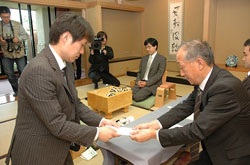
The first game of the title match was played at Matsusaki, an inn established in the Edo period, at Tatsuguchi Hot Spring, Nomi City, Ishikawa Prefecture on 13 and 14 May. The game ended at 7:53 p.m. on the second day after 259 moves.Taking white, Hane Naoki Honinbo won by 2.5 points. Of their eight-hour time allowances, Hane had three minutes left and Takao five.
In this game, the challenger Takao made a good start, building excellent thickness in a fight that started in the top right corner. He then played a tesuji in the second fight that expanded his lead. However, Hane countered with a do-or-die move that Takao answered too aggressively, in contrast to his calm play to this point. The result was a ko fight, but Takao made a bad ko threat, so Hane was able to throw the game into confusion. In the subsequent fight, Hane succeeded in upsetting Takao's lead. Hane owed his win to his tenacity and perseverance.
The second game will be played on 27 and 28 May.
Iyama wins Daiwa Net Grand
Champion tournament
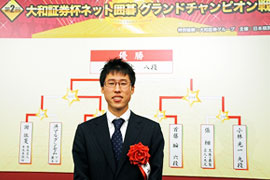
In the final of the 2nd Daiwa Securities Cup Net Igo Grand Champion Tournament, held on 21 March, Iyama Yuta 8-dan (B) defeated Shuto Shun 6-dan by half a point.
34th Meijin League
Iyama Yuta is moving closer and closer to a return match with Cho U. In a game played on 7 May, he defeated one of his two main rivals in the league, Sakai Hideyuki 7-dan, which improved his score to 6-0. The only player remaining with one win is Yamada Kimio 9-dan, who is on 5-1.
Results since our last report:
| ( 2 April ) |
Iyama Yuta 8-dan (W) beat Cho Chikun, 25th Honinbo, by resignation.
Sakai Hideyuki 7-dan (B) beat Kobayashi Satoru 9-dan by resignation. |
| ( 9 April ) |
O Meien 9-dan (W) beat Cho Riyu 7-dan by resignation. |
| ( 16 April ) |
Yamada Kimio 9-dan (W) beat Ogata Masaki 9-dan by resignation. |
| ( 19 April ) |
Kobayashi Satoru 9-dan (B) beat Cho Riyu 7-dan by resignation. |
| ( 7 May ) |
Iyama Yuta 8-dan (W) beat Sakai Hideyuki 7-dan by resignation.
Takao Shinji 9-dan (B) beat Cho Riyu 7-dan by 2.5 points.
Yamada Kimio 9-dan (B) beat Cho Chikun, 25th Honinbo, by half a point. |
| ( 14 May ) |
Kobayashi Satoru 9-dan (W) beat Ogata Masaki 9-dan by resignation. |
Michael Redmond reaches 500-win landmark
Michael Redmond 9-dan has reached a significant benchmark in his trailblazing career. On 23 April, he scored the 500th official win of his career. His record at this point was 500 wins, 331 losses, 2 jigos. This gives him a very respectable winning percentage of exactly 60%.
Recent results:
( 23 April )
Redmond (B) beat Komatsu Eiko 3-dan by 7.5 points
(Preliminary C, 58th Oza tournament). |
( 14 May )
Redmond (B) beat Terayama Rei 1-dan by resignation
(Preliminary B, 36th Tengen tournament). |
Gosei challenger: Yuki or Iyama
Yuki Satoshi 9-dan and Iyama Yuta 8-dan have made the play-off to decide the challenger for the 34th Gosei title. In the semifinals, Yuki (B) beat Takemiya Masaki 9-dan by 4.5 points and Iyama (B) beat Takao Shinji 9-dan by 3.5 points.
The play-off will be held at the end of this month. If Yuki wins, he will be making his fourth Gosei challenge while Iyama would be making his first.
Promotions
There have been three promotions by the cumulative-wins system. Araki Issei was promoted to 6-dan (90 wins), Yanagisawa Satoshi to 3-dan (40 wins), and Mukai Kaori to 2-dan (30 wins).
Kubomatsu Katsukiyo promoted to 9-dan
There was another promotion besides the above three, but it came over 67 years after the player's death. Kubomatsu Katsukiyo was simultaneously awarded the rank of 9-dan by the Nihon Ki-in and the Kansai Ki-in in March this year. Kubomatsu was a prominent player and teacher in the Kansai area who discovered and nurtured the talent of a number of great players. In 1920, he sent the 13-year-old Hashimoto Utaro, later founder of the Kansai Ki-in, to Tokyo to become the disciple of Segoe Kensaku, then 5-dan. The following year, he entrusted the 12-year-old Kitani Minoru to the tutelage of Suzuki Tamejiro, then 5-dan. These two had a great influence on the development of 20th-century go.
Kubomatsu was nicknamed `the great amateur' for his free and original style, which struck some as unprofessional because of his disdain for convention. Another prominent disciple was Maeda Nobuaki, who became known as `the god of tsume-go (life-and-death problems)'. Kubomatsu was also 8-dan at renju (five-in-a-row).
Kubomatsu's oldest active disciple, the 89-year-old Kubouchi Shuchi 9-dan, received the Kansai Ki-in and Nihon Ki-in diplomas on behalf of his teacher at a ceremony held in Osaka on 14 March. The Nihon Ki-in diploma was signed by, among others, Otake Hideo, Chairman of the Nihon Ki-in Board of Directors, who, as a disciple of Kitani, is a grandchild disciple of Kubomatsu.
A marriage
There has been yet another marriage between professionals at the Nihon Ki-in. The latest couple is Mukai Kaori, then 1-dan, and Mimura Tomoyasu 9-dan. The two registered their marriage on 1 January this year (all that's necessary to become legally married in Japan is for both partners to affix their seals to a marriage document and present it at their local ward or city office). They plan to hold a ceremony in May.
We have lost count, but there are at least 15 or 16 professional couples in Japan.
Retirement
Narusawa Yasuichi 8-dan (born in 1956) retired as of 31 March. Narusawa beame a professional in 1978 and reached 8-dan in 1998. He came second in the 13th King of the New Stars title in 1988.